Hot Shortness in Die Casting: Causes, Identification and Prevention
Hot shortness (hot tearing) in die casting: late-solidification cracking mechanism, alloy and impurity causes, how to tell hot tears from cold cracks, and proven prevention.
Production Capabilities
Defect reference visuals for hot shortness
Defect Identification
Visual references including defect photographs, X-ray inspection, CT scans, and sectioned samples for accurate defect recognition.
Process Control
Tooling adjustments, gating modifications, leak testing, and inspection procedures for die casting defect prevention.
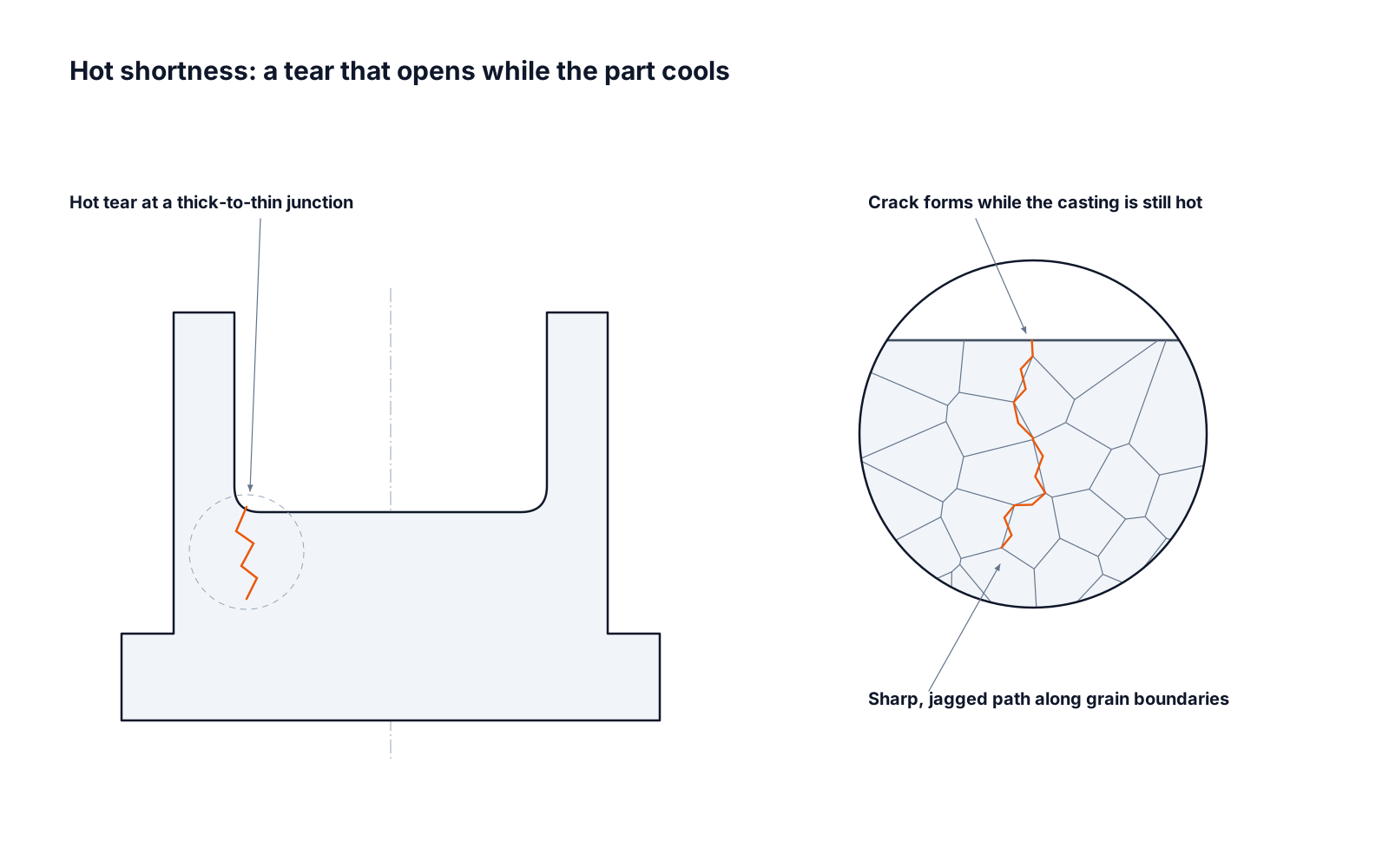
Hot shortness is a crack that forms in the final stage of solidification, while the casting is still partly liquid and the solid skeleton is too weak to carry tensile strain. It is not porosity and not a cold shut -- those are void or unbonded-interface defects. Hot shortness is a crack: an open separation through the metal. You may also meet it under the names hot tearing or hot cracking; all three refer to the same event.
The timing makes this defect deceptive. The crack opens inside the die, but it is often discovered only after ejection -- and a marginal tear can propagate further during machining, handling, or even in service. A part that looked acceptable at the press can fail at the customer's first machining pass.
The Mechanism - Why It Cracks While Still Hot
In the last stage of solidification the casting is a mushy zone. Dendrites and grains have grown into a continuous skeleton, but low-melting liquid films still sit between dendrite arms and along grain boundaries. Solidification shrinkage and thermal strain now load this semi-solid network. Where residual liquid can still flow in and feed the shrinking region, the network holds. Where the feed path is already cut off, the liquid film is pulled apart -- a crack opens.
Two details matter for both diagnosis and prevention:
The crack forms above the solidus. Hot shortness is not a defect of fully solid metal. It happens in the temperature window where a solid skeleton exists but cannot yet bear tensile strain. This is why the tear almost always appears at the last places to solidify -- the hot spots.
Segregation extends the vulnerable window. As solidification proceeds, rejected solute enriches the residual liquid at grain boundaries. The enriched films are lower-melting and delay the formation of strong bridges between grains, so the weak state persists longer.
Alloys with a wide freezing range are more sensitive because the mushy zone -- the vulnerable window -- is long. Freezing range is not the only predictor, but it is a useful first screen. For reference, A380 aluminum has a nominal melting/solidification range of about 540-595 C, roughly 55 C wide.
Where Hot Tears Appear - Predictable Locations
Hot shortness is a local event. The tear forms where the casting solidifies last and shrinks under restraint:
- Isolated thick sections: bosses, pads, and heavy nodes stay liquid longest and solidify under constraint from the already-rigid walls around them.
- Thick-to-thin junctions: the thin wall solidifies first and becomes rigid; the still-shrinking thick section is tied to it.
- Corners constrained by cores and slides: a core or slide that grips the casting as it cools restrains shrinkage in tension.
- Regions far from the gate: poor gating and overflow layout starves them of feed metal and of pressure transmission at the critical moment.
- Features near ejector pins on a too-hot casting: early ejection converts these weak sections into mechanical tears.
Because every one of these locations solidifies last, the tear location on the part is itself diagnostic -- it points at the hot spot and at the restraint.
Alloy and Impurity Causes
Composition controls how long the vulnerable mushy state lasts and how well the residual liquid can feed it.
Iron (Fe) -- a frequent misunderstanding. Fe is added to aluminum die casting alloys to prevent die soldering. It is not a remedy for hot tearing. Excessive Fe forms brittle Fe-rich intermetallic phases that reduce ductility and feeding ability, and can aggravate cracking. The net effect depends on the Fe/Mn balance and on the morphology of the Fe-rich phases -- so Fe belongs inside the grade specification, not above it "for insurance."
Magnesium (Mg). Excess Mg raises the hot tearing tendency in certain aluminum grades. Treat the specified range as a limit, not a target.
Copper (Cu). Cu changes the solidification path, but the effect is alloy-specific. There is no universal rule that more Cu or less Cu helps; hold it to the grade spec.
Zinc (Zn) and tin (Sn). In aluminum, these impurities segregate to grain boundaries and form low-melting films -- exactly the condition that feeds a tear. They are a critical control item when the charge includes recycled or mixed material.
Zinc die casting alloys. In Zn alloys, excess Mg and an unbalanced Al/Zn/Mg ratio increase hot ripping risk; the same segregation logic applies.
Geometry and Process Causes
Whatever the alloy, the tear needs a local hot spot plus restraint. The usual combinations:
Constraint from tooling features. Ribs, bosses, cores, and slides that restrain shrinkage load the semi-solid network in tension. A slide that grips the casting as it contracts is a classic tear starter.
Abrupt thick-to-thin transitions. The thick section is the hot spot; it solidifies last. When the thin walls around it have already frozen rigid, they restrain its contraction.
Sharp corners. A sharp internal corner concentrates stress on the weakest region of the wall. Generous fillets spread the load. Fillet design is one of the main hot-tear prevention levers at the drawing stage.
Uneven wall thickness. Sections that vary in thickness solidify at different times; the late sections shrink under restraint from the early ones.
Die temperature -- a window, not a target. Too cold, and the surface freezes early while the interior lags, building a steep temperature gradient. Too hot, and the casting stays weak for longer while hot spots grow. In aluminum HPDC, die surface temperatures around 180-250 C are a common starting range -- optimize within the window per part, and do not read it as a universal specification.
Premature ejection. A casting ejected while still hot and weak can tear at cores and ejector pins. Strictly, this is mechanical tearing of a hot, weak casting -- but it looks like a hot tear, and it is prevented the same way: enough time in the die for the casting to gain strength before ejection.
Poor gating and overflow design. Gates and overflows must deliver fill and transmit intensification pressure to the regions that solidify last. A bad layout leaves the liquid films under strain with no feed metal available.
Uneven release agent is an indirect factor: it disturbs local die temperature and, with it, the local solidification sequence.
Hot Tear vs Cold Crack - How to Tell
Misdiagnosing the crack leads to the wrong fix. Read formation time, location, morphology, and fracture surface together:
| Criterion | Hot Tear | Cold Crack / Mechanical Crack |
|---|---|---|
| Formation time | End of solidification, above the solidus | After solidification: ejection, handling, machining |
| Typical location | Hot spots, thick-to-thin junctions, constrained corners | Ejector pin marks, stuck cores, clamping points |
| Morphology | Irregular, branched, follows grain boundaries | Straighter, more direct path |
| Fracture surface | Oxidized and darkened (formed hot, exposed to air) | Clean and brighter (formed cold) |
| Process clue | Repeats at the same hot spot on shot after shot | Shows up after ejection or in downstream operations |
Visual criteria are useful but not absolute. When the distinction will drive a tooling or design decision, confirm with metallography: a hot tear runs intergranular or interdendritic along the segregated films, which a cold fracture does not.
Prevention Checklist
- Choose the alloy for solidification behavior. Weigh freezing range and feeding behavior against the actual geometry -- and do not add Fe to prevent hot tearing.
- Hold composition inside the grade specification: Fe (watch the Fe/Mn balance and Fe-rich phase morphology), Mg, Cu, and impurity Zn and Sn -- especially with recycled charge.
- Design uniform wall thickness and grade thickness gradually where thick meets thin, so no isolated hot spot freezes last under restraint.
- Use generous fillets at ribs, bosses, and corners to remove stress concentration.
- Minimize restraint from tooling: reduce core and slide constraint, and provide sufficient draft so features release cleanly as the casting shrinks.
- Balance die temperature across the cavity and eliminate local hot spots; treat die temperature as a control window, not a hotter-is-better dial.
- Design gates and overflows to secure fill and pressure transmission to the last-solidifying regions.
- Allow sufficient dwell time in the die so the casting leaves with enough strength to survive ejection.
- Eject evenly: a uniform ejector pin layout, no stuck cores, no single pin carrying the load.
- Apply release agent uniformly to avoid local temperature disturbances.
Seeing cracks at ribs or thick-to-thin junctions? Send photos and the drawing to casting@kastdiecast.com - we will tell you whether it is hot tearing or an ejection crack | +86 138 1403 4409 | No.6, Rungu Road, Nanjing, China
Related Defects
- die casting warpage -- same residual-stress family as hot tearing, but expressed as distortion rather than an open crack
- die casting shrinkage porosity -- the feeding failure that a hot tear completes into a crack
- die casting soldering and blistering -- the defect Fe is actually added to prevent
- die casting defects overview
- fillet vs chamfer -- fillet design is a primary hot-tear prevention tool
Related Resources
Next steps for hot shortness
Gas Porosity in Die Casting: Causes and Prevention
Gas porosity die casting guide: formation mechanisms, ASTM E505 classes, X-ray and CT detection, consequences for sealing and strength, and prevention.
Defect GuideCold Shut Die Casting: Causes and Prevention Guide
Cold shut die casting defect guide: how partially solidified flow fronts fail to fuse, how to identify cold shuts, and design and process prevention.
Quality GuideDie Casting Defects
Compare common defect types, causes, and corrective actions from a buyer and engineering perspective.
CapabilityQuality Control
Review inspection workflow, traceability support, and process control standards before launch.
Process GuideDie Casting Process
See how casting, trimming, machining, finishing, and inspection fit together in production.
Next StepRequest a Quote
Send your drawing package and target volume to get an engineering-backed quotation.
Need a Quote for Your Project?
Our engineering team is ready to review your requirements and provide competitive pricing with fast turnaround.
Request a Quote