Die Casting Tooling Steel: H13 vs P20 Compared
Compare H13 vs P20 die casting tooling steel for die life, heat checking, prototype tools, production tools, cost, and buyer decisions.

Technical Director, Die Casting Engineering
Blog Visual Plan
Article visuals for H13 vs P20 die casting
These visuals use your current KastMfg image library now, and they will automatically switch to article-specific images when you add them later.
Lead Technical Image
Add a hero-level manufacturing, tooling, or component image that reinforces the article topic above the body copy.
Comparison or Detail Image
Reserve a second image for an alloy comparison, defect example, tooling detail, or application close-up deeper in the article.
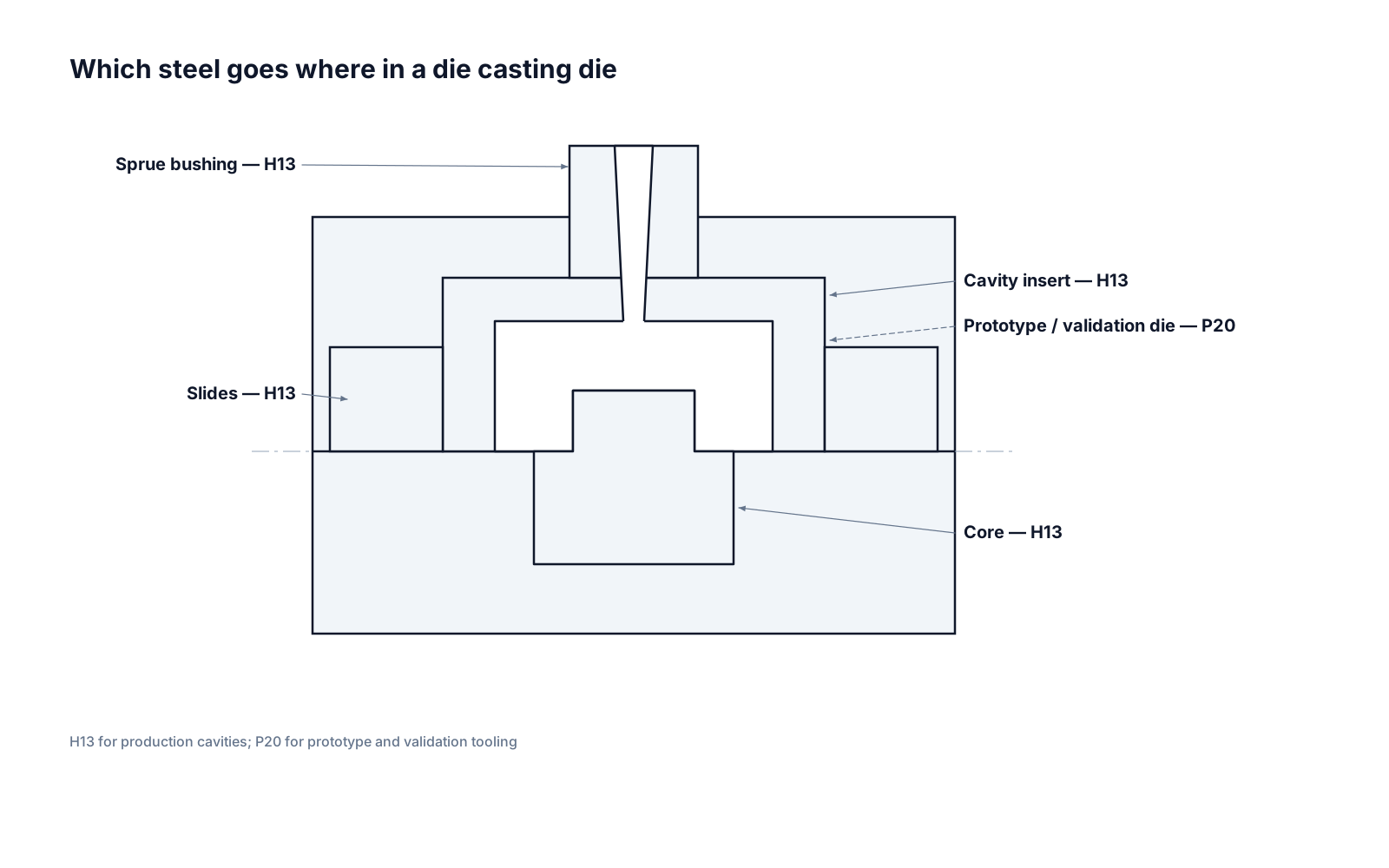
H13 and P20 are both tool steels, but they are not equal choices for die casting. H13 is the standard for production die casting cavities because it handles thermal fatigue, heat checking, and high-temperature injection cycles better. P20 is more common for prototype tooling, fixtures, or support components that do not contact molten metal directly.
For buyers, the tooling steel decision should match alloy, production volume, part geometry, expected die life, and whether the tool is for sampling or mass production.
Specifying the die you are about to buy? H13 for production cavities; P20 for prototype and validation tools. KastMfg builds both in-house - P20 prototype tooling in 3-5 weeks, H13 production tooling in 5-8 weeks, with first article a further 1-2 weeks. See die casting tooling, tooling lead time, or send the part drawing to the RFQ desk.
Quick Comparison
| Factor | H13 | P20 |
|---|---|---|
| Best fit | Production die casting dies | Prototype, low-volume, or non-cavity components |
| Hardness after treatment | 44-48 HRC (heat treated) | 28-34 HRC (pre-hardened, used as-is) |
| Heat resistance | Strong — withstands repeated 600-700°C thermal cycles | Lower — softens with repeated high-temperature exposure |
| Thermal fatigue resistance | Strong | Limited |
| Tool life (aluminum HPDC) | 100,000-500,000+ shots depending on part and process | Typically under 50,000 shots before visible wear in casting conditions |
| Cost | Higher upfront | Lower upfront |
| Common use | Cavity inserts, cores, slides for production | Prototype inserts, holders, support plates, fixtures |
Why H13 Is the Standard for Die Casting
H13 (DIN 1.2344, JIS SKD61) is a chromium-molybdenum-vanadium hot-work tool steel designed for repeated thermal shock. Its composition — typically 5% chromium, 1.3% molybdenum, 1% vanadium — provides the combination of hot hardness, toughness, and heat checking resistance that molten metal injection demands.
Every shot cycle, the die cavity surface heats rapidly as molten metal fills at 20-100 m/s, then cools under water or oil cooling. H13 is engineered to survive hundreds of thousands of these cycles without cracking or deforming.
H13 is typically specified when:
- Annual volume is medium to high (typically above 10,000 parts per year).
- Aluminum, magnesium, or high-temperature zinc die casting is required.
- The part has complex ribs, deep cores, thin walls, or critical sealing surfaces.
- The buyer expects to transfer the tool or use it across multiple programs.
- Tool life and dimensional stability over time matter more than lowest upfront cost.
SKD61 — The Common Chinese and Japanese Equivalent
In Chinese and Japanese tooling practice, SKD61 (JIS standard) is the equivalent of H13. The two steels share nearly identical composition and heat treatment requirements. When Chinese die casting suppliers quote "H13 equivalent" or specify SKD61, they are referring to the same class of hot-work die steel.
Buyers reviewing Chinese supplier quotes should ask for:
- The specific steel grade name and standard (H13, DIN 1.2344, or JIS SKD61)
- The heat treatment hardness achieved (should be 44-48 HRC for cavity inserts)
- The steel mill certificate
Pre-hardened P20 delivered at 28-34 HRC will not hold up to aluminum die casting thermal cycles regardless of how it is marketed.
Nitriding — Surface Treatment That Extends H13 Die Life
Nitriding is a surface hardening treatment applied to H13 cavity inserts after machining. It creates a hard, wear-resistant surface layer (typically 0.1-0.3 mm deep) that reduces soldering, erosion, and heat checking without changing the bulk steel hardness.
Nitriding is commonly applied to:
- Gates and runners where high-velocity metal flow causes erosion
- Ejector pin holes subject to wear
- High-stress ribs and cores
Buyers should ask whether cavities are nitrided as part of the standard tooling build, since it is not always included in base quotations.
When P20 May Be Considered
P20 is pre-hardened to 28-34 HRC and does not require further heat treatment after machining. This makes it faster and cheaper to machine into prototype shapes. It is appropriate for:
- Short prototype sample runs (typically under 1,000-3,000 shots in zinc; fewer in aluminum).
- Tooling holders, clamp plates, and non-cavity support components.
- Fit check and DFM validation where thermal performance is not required.
- Fixtures and gauges.
P20 should not be presented as equivalent to H13 for production aluminum or magnesium die casting. Suppliers quoting P20 for high-volume production tooling should be asked to justify the steel selection.
Buyer Decision Table
| Project Requirement | Tool Steel Direction |
|---|---|
| Production aluminum die casting, any volume | H13 or SKD61, 44-48 HRC |
| Production magnesium die casting | H13 or SKD61 |
| Long-run zinc die casting (>100,000 shots) | H13 or suitable production die steel |
| Prototype zinc sample run (<3,000 shots) | P20 may be reviewed |
| Customer-owned production tooling | Specify H13, heat treatment, and hardness in the purchase order |
| Tool transfer to another supplier | Request steel certificate and heat treatment records before transfer |
| Textured or cosmetic cavity surfaces | H13 with polishing to SPI standard |
RFQ Questions to Ask the Supplier
- What steel will be used for cavity inserts and cores?
- What heat treatment process is planned, and what hardness will be achieved?
- Is nitriding included in the quoted tooling?
- What die life is expected for this part and volume?
- Which parts of the tool are H13 and which are support steel?
- Is the quoted tool for samples only or full production?
- Who owns the tool, and what documentation is included?
KastMfg quotes production tooling with clear steel grade, heat treatment, ownership terms, and maintenance documentation. Submit drawings through the RFQ page.
Common Buyer Mistakes
| Mistake | Result |
|---|---|
| Accepting P20 quote for production aluminum tooling | Early heat checking, dimensional drift, and short tool life |
| Not specifying hardness in the PO | Supplier delivers undertreated steel at lower hardness |
| Skipping nitriding to reduce cost | Faster gate erosion and die soldering |
| Not requesting steel certificates | No way to verify actual steel grade received |
| Confusing H13 and pre-hardened P20 on multi-source quotes | Unfair comparison and hidden long-term cost difference |
FAQ
Is H13 better than P20 for die casting?
Yes for all production die casting applications. H13 handles thermal fatigue, heat checking, and hot wear far better than P20. P20 is only suitable for prototype or non-cavity tooling.
What hardness should H13 die casting tooling be?
Production die casting cavities in H13 are typically heat treated to 44-48 HRC. Lower hardness means the steel was not properly treated and will not deliver expected die life.
Is SKD61 the same as H13?
SKD61 (JIS) and H13 (AISI) are nearly identical in composition and heat treatment. Chinese suppliers commonly use SKD61 as the equivalent of H13. Either is acceptable when delivered at the correct hardness.
What is nitriding and why does it matter for die casting?
Nitriding is a surface hardening treatment that creates a wear-resistant layer on H13 die surfaces. It reduces erosion at gates, soldering on cavity walls, and wear at ejector holes. It extends die life and reduces defect rates without affecting bulk steel hardness.
Can P20 be used for zinc die casting prototype tooling?
P20 can be used for limited prototype zinc tooling with very low shot counts (typically under 3,000). For sustained production runs at any volume, H13 or equivalent hot-work die steel is more appropriate.
How do I verify my supplier is using the correct steel?
Request the steel mill certificate (material cert) at tooling approval. The cert should identify the steel grade, heat, and chemical composition. Hardness should be verified by the supplier's incoming inspection records.
Does tool steel choice affect part quality?
Yes. Worn or under-hardened cavities lose dimensional accuracy over time, produce flash, increase porosity, and require more frequent maintenance. Correct steel choice and heat treatment is foundational to repeatable part quality.
Related
About The Author
Mike Yao on H13 vs P20 die casting
Technical Director, Die Casting Engineering
Technical Director at KastMfg with 20+ years in high-pressure die casting, leading engineering and program management across aluminum, zinc, and magnesium programs for automotive, EV, electronics, and medical OEMs worldwide.
View author profileRelated Reading
Keep exploring the blog
Die Casting vs Permanent Mold Casting: Which to Choose?
Die Casting vs Permanent Mold Casting: How to Choose Die casting and permanent mold casting are both metal mold processes - both use reusable steel or iron dies rather than expe...
Mike Yao
8 min read
Die Casting Die Explained - Anatomy, Steel, Life, and Cost
Die Casting Die - What It Is, How It's Built, and What It Costs A die casting die is a precision steel mold - typically two machined halves of H13 hot-work tool steel - that sha...
Mike Yao
5 min read
Die Casting Tooling Cost - Factors & Ranges
Die Casting Tooling Cost — What Drives It and How to Reduce It Die casting tooling is typically the largest single upfront investment in a casting program. A simple single-cavit...
Mike Yao
6 min read
Can Steel Be Die Cast? Why Conventional HPDC Says No
Can Steel Be Die Cast? Why Conventional HPDC Says No No - steel cannot be made by conventional high-pressure die casting. The commercial process is limited to zinc, magnesium an...
Mike Yao
6 min read