Aluminum Grades: Wrought & Cast Designation Chart
Aluminum grades explained with charts for both systems: the wrought 1xxx-8xxx series by alloying element, cast 1xx.x-7xx.x designations (A380, A383, A413 in 3xx.x), the ADC12 JIS vs AA equivalence trap, and temper codes F, O, T5, T6 and H.

Technical Director, Die Casting Engineering
Blog Visual Plan
Article visuals for grades of aluminum
These visuals use your current KastMfg image library now, and they will automatically switch to article-specific images when you add them later.
Lead Technical Image
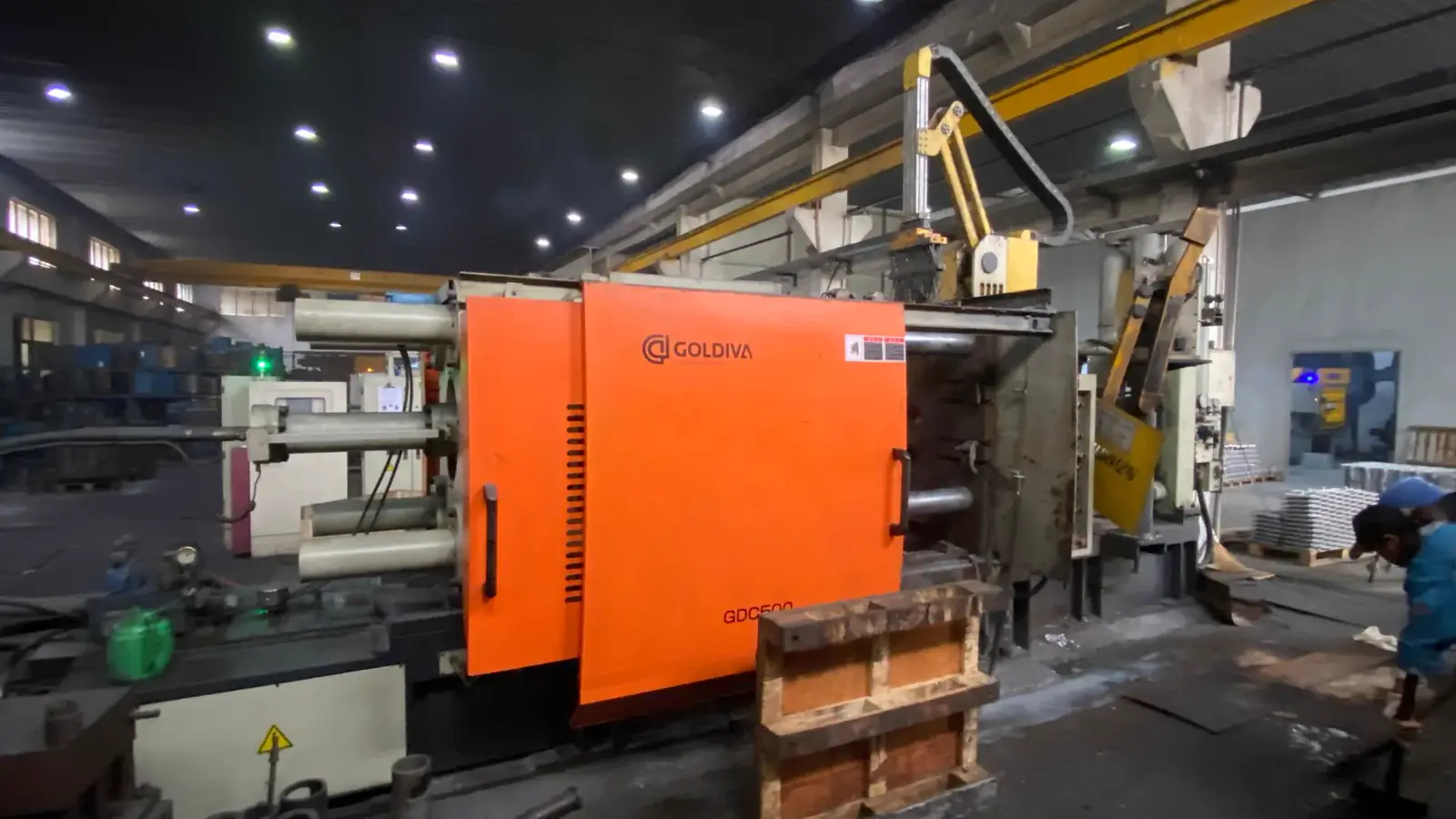
Add a hero-level manufacturing, tooling, or component image that reinforces the article topic above the body copy.
Comparison or Detail Image
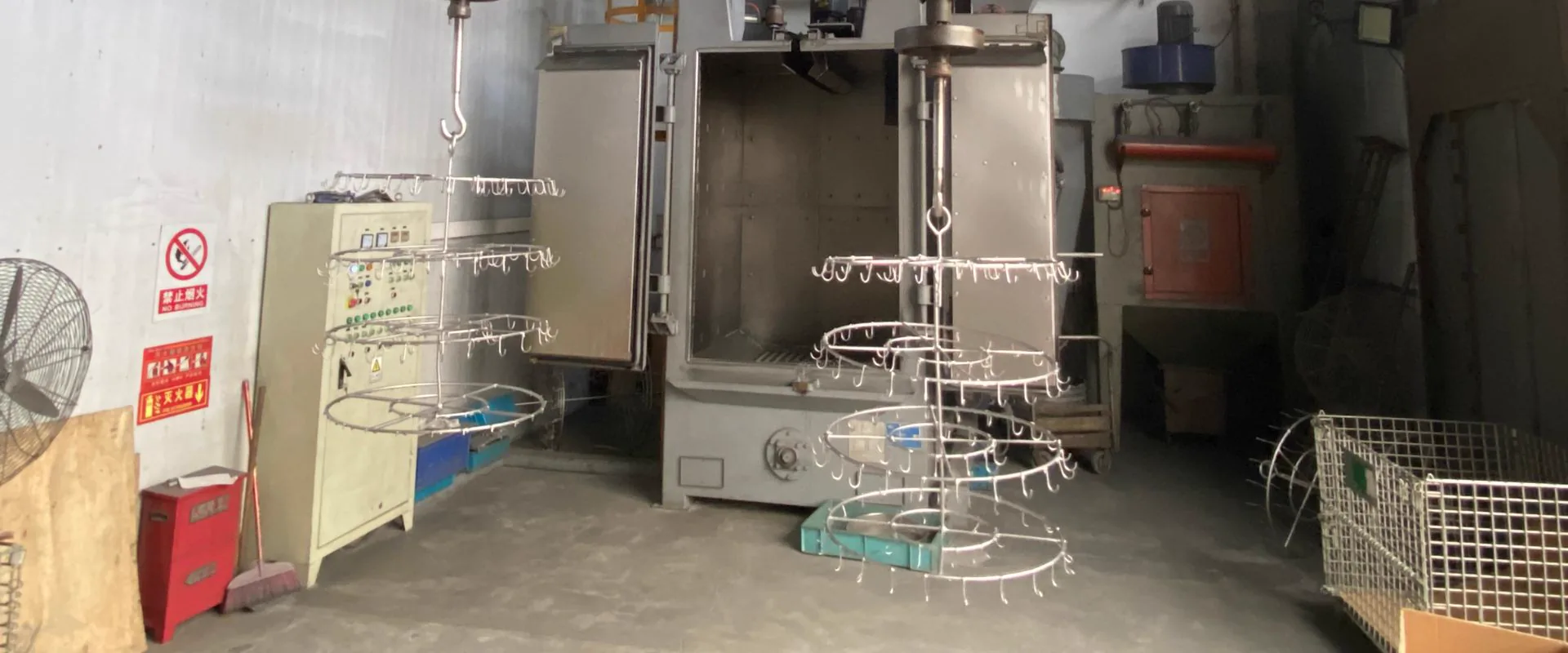
Reserve a second image for an alloy comparison, defect example, tooling detail, or application close-up deeper in the article.
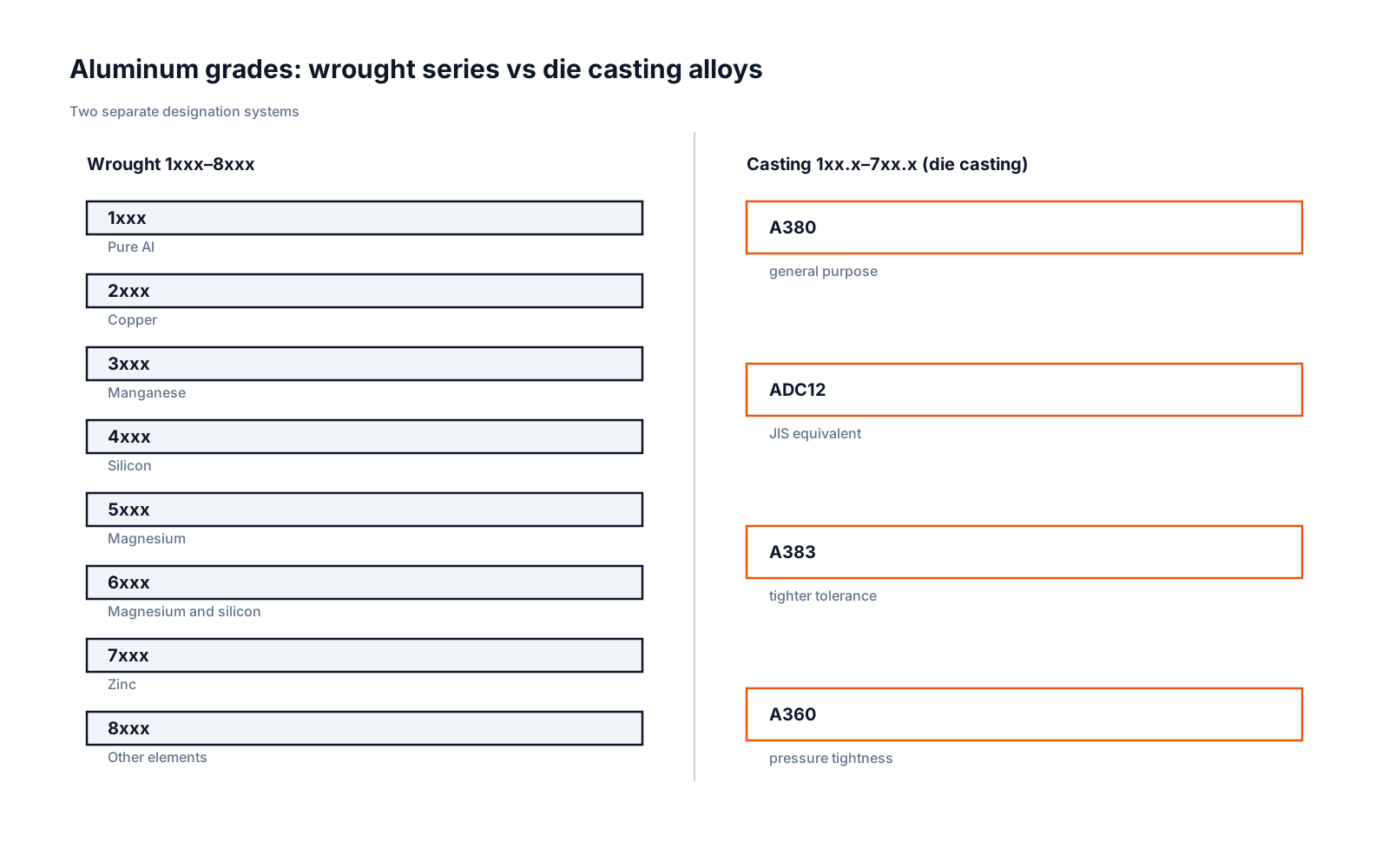
Aluminum grades fall into two separate designation systems: wrought alloys numbered 1xxx-8xxx and casting alloys numbered 1xx.x-7xx.x. The wrought system runs four digits, the cast system three digits plus a decimal point, and in both the leading digit signals the principal alloying element. That one rule decodes most grade numbers a buyer meets: 2xxx and 2xx.x are copper alloys, 5xxx and 5xx.x are magnesium alloys, 7xxx and 7xx.x are zinc alloys - and the die casting workhorses A380, A383, A360 and A413 all belong to the silicon-bearing 3xx.x family.
This page is the working reference for aluminum alloy grades: both charts (the wrought 1xxx-8xxx series chart and the cast aluminum designations chart), where each die casting grade sits, the JIS-versus-AA trap behind ADC12, what T5 and T6 mean, and what to write on a drawing.
The Wrought Aluminum Grades Chart: 1xxx Through 8xxx
Wrought grades are the aluminum series shaped by working the metal - rolling, extrusion, forging or drawing. The four-digit number encodes the family:
| Series | Principal element | Representative grades | Why a die casting buyer cares |
|---|---|---|---|
| 1xxx | None - 99%+ pure aluminum | 1100, 1350 | Electrical and corrosion duty; not a casting family |
| 2xxx | Copper | 2024, 2219 | Aircraft sheet and fasteners; copper's strengthening role reappears in cast 2xx.x and 3xx.x |
| 3xxx | Manganese | 3003, 3105 | Heat exchanger and HVAC sheet; moderate strength, excellent formability |
| 4xxx | Silicon | 4043, 4032 | Welding wire and pistons; silicon is the element that makes casting alloys flow |
| 5xxx | Magnesium | 5052, 5754 | Marine and general-purpose sheet; good weldability and corrosion behavior |
| 6xxx | Magnesium + silicon | 6061, 6063 | The extrusion family - 6063 is the classic heat sink profile grade |
| 7xxx | Zinc | 7075 | Highest-strength wrought family; aerospace structure |
| 8xxx | Other elements | 8011, 8090 | Foil grades and specialty additions such as iron or lithium |
None of the wrought rows are die cast grades: a drawing that specifies 6061-T6 for a die casting project is really asking for a machined or extruded product. Note where silicon sits - wrought 4xxx is a niche of welding wire and pistons, but silicon is the most important die casting alloying element, which is why nearly every commercial HPDC grade clusters in the cast 3xx.x family. The boundary case - extruded fins versus cast bodies - is covered in die casting heat sinks.
Cast Aluminum Designations: The 1xx.x-7xx.x Chart
Cast aluminum designations run three digits plus a decimal; under the Aluminum Association system the digit after the decimal separates the casting composition from ingot compositions of the same number, and a letter prefix - the A in A380 or A413 - marks a modification of the original alloy:
| Series | Principal element | Representative grades | Where you meet it |
|---|---|---|---|
| 1xx.x | None - 99%+ aluminum | (rarely specified) | Purity castings for electrical and chemical duty; not a die casting route |
| 2xx.x | Copper | A201.0, 204.0 | High-strength sand and permanent-mold castings; heat-treatable |
| 3xx.x | Silicon, with copper and/or magnesium | 319.0, A356.0, plus A360, A380, A383, A413, A390 | The die casting family - most commercial HPDC grades live here |
| 4xx.x | Silicon (binary Al-Si) | 443.0 | General-purpose sand and permanent-mold castings |
| 5xx.x | Magnesium | 514.0, A535.0 | Corrosion-resistant castings with a marine leaning |
| 6xx.x | Not used | - | The 6xx.x series is not used in the casting designation system |
| 7xx.x | Zinc | 713.0, 771.0 | Specialty sand and permanent-mold grades; rarely cross a die casting RFQ |
The A413 quirk - read this twice. A413's number looks like a 4xx alloy, but under the Aluminum Association classification A413 belongs to the 3xx.x family, not to 4xx.x. Charts that file it under 4xx.x are sorting by digits instead of by the AA series definition. The reason to care: the 3xx.x family shares a behavior profile - silicon-driven castability with copper and magnesium tuning strength - and A413's near-eutectic silicon level is why it fills thin walls so readily.
The die casting shortlist lives almost entirely in that row: A380 as the North American default, A383 where intricate fill matters, A360 for strength-critical housings, A413 for thin-wall fluidity, A390 where high silicon buys wear resistance. The aluminum casting alloys guide walks that selection; alloy data starts at materials overview and aluminum for die casting, with process context in aluminum die casting.
AA vs JIS Designation: The ADC12 Equivalence Trap
The Aluminum Association system governs North American practice. Japanese drawings arrive in the JIS system, where die castings are specified in the ADC series defined by JIS H 5302 - ADC1, ADC3, ADC10, ADC12 and so on. The numbers do not translate one-to-one, and that produces the most common designation error on casting drawings.
ADC12 is a JIS designation, approximately equivalent to A383 in the Aluminum Association system - and the equivalence is approximate. ADC12 is not an AA grade. Its composition range sits close to A383's, which is why the two are routinely cross-referenced, but each standard sets its own limits and qualification routine. "Close enough" is a sourcing judgment, never a standards fact.
What that means at the desk:
- Write system, grade and product standard together: "A383 per ASTM B85" or "ADC12 per JIS H 5302". A bare number invites the supplier to ship whichever system they stock.
- Never write "ADC12 (AA)" or "A383/ADC12" as a single alloy - that conflates two standards into a grade that exists in neither.
- If a supplier proposes the other system's near-equivalent - ADC12 for A383, or the reverse - treat it as a substitution: compare the two composition sheets, confirm the properties the part needs, and record the agreement before production.
For the chemistry behind the most common pairing, see ADC12 vs A380.
Temper Codes: F, O, T5, T6 - and the Wrought-Only H
The grade names the chemistry; the temper names the delivered condition, appended after a hyphen (6061-T6, A356-T6). The codes a casting buyer meets:
- F - as fabricated. No special thermal control; the default for most conventional high-pressure die castings.
- O - annealed. Softened by heat; the softest condition of a given grade.
- T5 - cooled from an elevated-temperature forming process, then artificially aged. The qualifier is load-bearing: T5 does not mean "artificially aged" in general. The aging follows directly on cooling from the forming temperature, with no separate solution treatment in between.
- T6 - solution heat treated, then artificially aged. The full heat-treated condition.
- H - strain hardened. H tempers apply to wrought products only: they describe cold work built into rolled or drawn product. A die casting has no strain-hardening step, so an H temper on a casting callout is an error, not a stricter requirement.
On the shop floor, conventional HPDC parts generally ship as-cast; the T designations a die casting buyer meets tend to sit on sand and permanent-mold alloys such as A356-T6. What a temper does to the numbers is a separate question - yield strength of aluminum carries the strength data and the metal hardness chart the hardness side.
What Buyers Should Write on the Drawing
One habit prevents most alloy disputes: specify designation, system and standard in one callout. A die cast part should carry a cast designation; a 6061 callout on a die cast RFQ signals wrought intent - machined from billet or extruded - and is better resolved before tooling than at first article.
Mixed-system documents are the second recurring risk: a BOM listing ADC12 while the drawing notes A383, or an inspection report checked against the wrong standard's limits. Pick one system per part and route any proposed swap through the substitution steps above.
Put surface requirements on the same drawing: a deburr or edge-break note usually routes the part through a mass finishing step such as vibratory finishing, whose media choices interact with the alloy and its supplied condition.
Frequently Asked Questions
What is the difference between wrought and cast aluminum grades?
Two designation systems, not one ladder. Wrought grades run 1xxx-8xxx in four digits for rolled, extruded, forged or drawn product; cast designations run 1xx.x-7xx.x in three digits plus a decimal for shape-cast product. They are parallel families - A380 is not "the cast version of" any wrought grade.
Is ADC12 the same as A383?
No. ADC12 is a JIS designation and A383 is an Aluminum Association grade. The two are treated as approximately equivalent because their composition ranges sit close together, but the equivalence is approximate - specify one system and standard, and treat any swap as a substitution to verify.
What does the T5 temper mean?
Cooled from an elevated-temperature forming process, then artificially aged - not artificial aging in general, and not a substitute for T6's solution treatment. On castings it appears mainly on sand and permanent-mold grades, not conventional HPDC product.
Related
- aluminum casting alloys - the die casting alloy selection guide
- ADC12 vs A380 - the JIS/AA pairing in full chemistry
- aluminum for die casting - the alloy family in process context
- yield strength of aluminum - what temper codes do to strength
- metal hardness chart - the hardness ladder for the same grades
- request a quote
Alloy grade question on a casting? Send your package through the request a quote page or email casting@kastdiecast.com:
- CAD or PDF drawing of the final part
- Alloy and designation system - AA cast grade, JIS grade, or open selection
- Annual volume and expected program life
- Key dimensions and wall thickness range
- Surface treatment, if any
- Test requirements, including material or temper validation
- Destination country and delivery term
KastMfg Manufacturing Co., Ltd. Email: casting@kastdiecast.com | Phone: +86 138 1403 4409 No.6, Rungu Road, Nanjing, China
About The Author
Mike Yao on grades of aluminum
Technical Director, Die Casting Engineering
Technical Director at KastMfg with 20+ years in high-pressure die casting, leading engineering and program management across aluminum, zinc, and magnesium programs for automotive, EV, electronics, and medical OEMs worldwide.
View author profileRelated Reading
Keep exploring the blog
Thermal Conductivity of Aluminum: Alloy Chart
Thermal Conductivity of Aluminum: Alloy Chart The thermal conductivity of aluminum is approximately 237 W/m·K for the pure metal - and almost nothing ships as pure aluminum. The...
Mike Yao
7 min read
Aluminum Casting Alloys - Complete Selection Guide
Aluminum Casting Alloys - The Complete Selection Map Aluminum casting alloys look like an alphabet soup - A380, A356, ADC12, 319, 535 - but the logic is simple once you sort the...
Mike Yao
3 min read
Yield Strength of Aluminum: Alloy Chart
Yield Strength of Aluminum: Alloy Chart The yield strength of aluminum is only about 25-35 MPa in the pure, annealed metal - and roughly ten times that in a heat-treated enginee...
Mike Yao
7 min read
Density of Aluminum - Pure Metal and Die Casting Alloys Chart
Density of Aluminum - and the Die Casting Alloy Chart The density of aluminum is 2.70 g/cm3 (0.0975 lb/in3) for the pure metal. The aluminum alloy density spread from there is r...
Mike Yao
7 min read